Aloha State Daily <> Piʻikū Co.
Carlo Liquido, Exec. Director
Had a conversation with Aloha State Daily this morning about where Piʻikū is heading. One big point I wanted to get across is that the conditions for tech services exist in Hawaiʻi but the industry is underperforming. Although Piʻikū Co. (piiku.co) exists to create opportunities for new talent, we also need to find what's blocking the ecosystem from growing and help remove it.
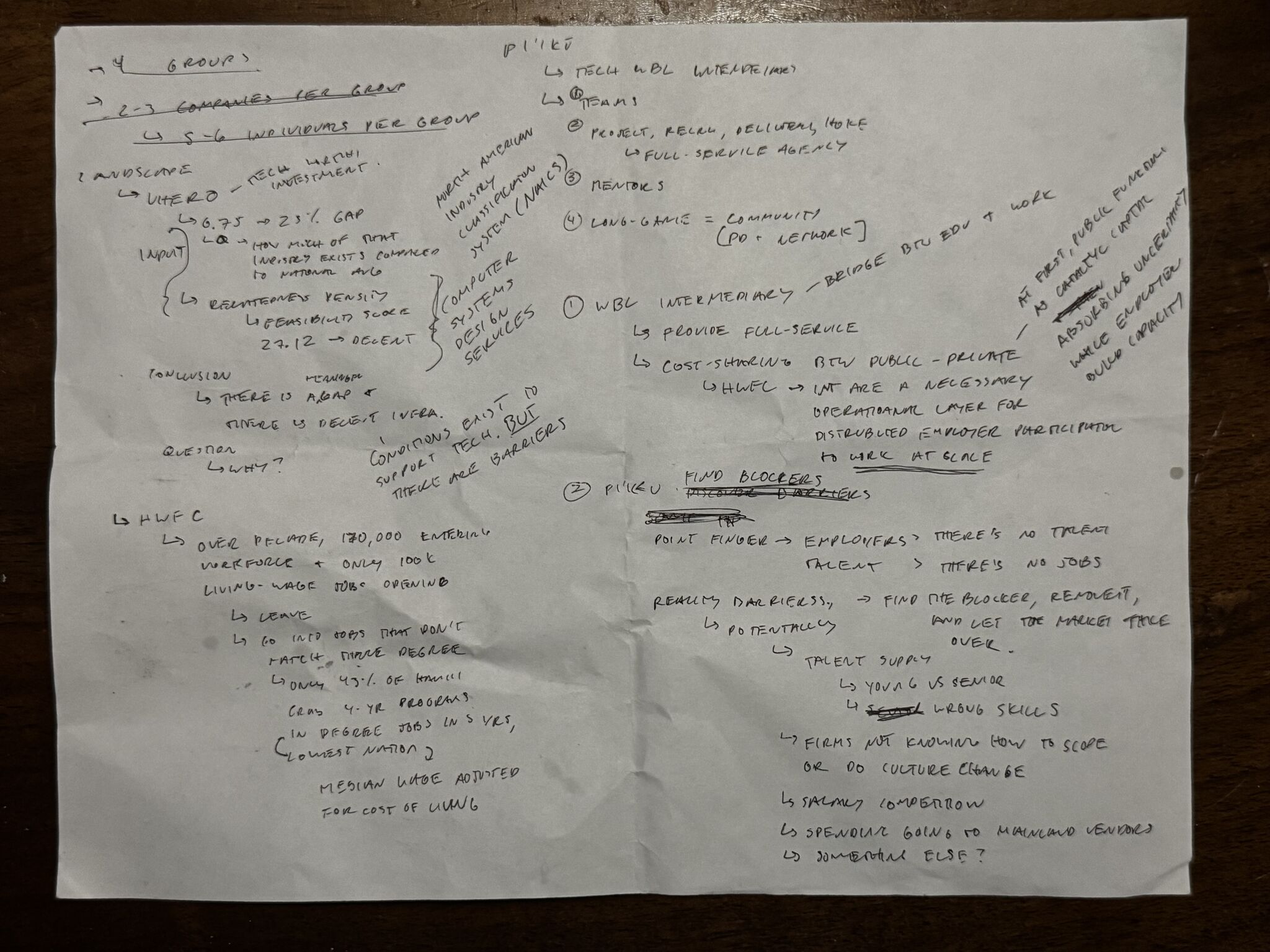
Brought a page of messy notes going in. Here's what I was working through.
UHEROʻs report on diversifying Hawaiʻi's economy found that Computer Systems Design Services — one of the core tech service categories — has a Location Quotient of 0.75 in Honolulu. That's one category within tech services, and I'm using it as directional for the sector overall. It means for every 4 tech services jobs the national pattern predicts, we have 3. Thatʻs a 25% gap.
But the relatedness density is 27.12 — a measure of how many supporting industries already exist locally. It means many of the building blocks are here. I don't believe 0.75 is the natural equilibrium of this industry in Hawaiʻi. So when the conditions exist but an industry is underperforming, there's a bottleneck. Find it, remove it, and the market can do the rest.
But state research points to macro conditions — it doesn't tell us what the blockers actually are. Anecdotally we've heard a range: talent supply and job demand mismatch, firms don't know how to scope tech work or do culture change, salary competition with the mainland, spending going to mainland or other outsourced vendors instead of local talent. Piʻikū is putting together a convening later this Summer of Hawaiʻi's legacy employers to figure out what's actually in the way.
What's also clear is that even once we know, it's not something employers can do alone. As the Hawaiʻi Workforce Funders Collaborative lays out, there's a cost-sharing model between public and private. The exact pathway is unclear, but to me, the likely answer is that public functions as catalytic capital in the beginning to absorb the uncertainty while employers build capacity. That's what we're seeing across our program sites — the desire is there, but building real tech capacity is a 5-10 year commitment that requires intermediaries (like Piʻikū) and capital.